Notes about birds, birding and travel from the Pioneer Valley in Western Massachusetts.
Tuesday, October 11, 2011
MA - lingering warblers - 10/11
Another early morning shrouded in fog but clearing by 9am, and developing into another glorious fall day. I swung by Barton Cove on the way to an appointment and found little in the way of waterfowl except a Green-winged Teal with the Canada Geese. However, a nice feeding flock of passerines in a yard just off Riverview Drive immediately grabbed my attention and I regretted having restrictions on my time. In just ten minutes I had excellent views of Ruby and Golden-crowned Kinglets, Blue-headed Vireo, and Blackpoll, Tennessee and Black-throated Green Warblers. The Tennessee Warbler in particular was a nice find being my first locally since a singing bird in our yard in late May.
JPS
Monday, October 10, 2011
MA - yard Winter Wren - 10/10
Eastern Phoebe - Gill yard, Franklin Co., MA. October 5th, 2011. One of at least three lingering in the yard until at least October 10th. First bird of the morning was an Eastern Winter Wren giving hard chip notes from the undergrowth below our kitchen window. Certainly a 'yard bird', though there's at least one breeding pair less than a half mile up-river along Darby Brook. Post breeding dispersal perhaps?
Another very foggy dawn was breaking when I was surprised but pleased to hear a Swainson's Thrush actually singing (rather than just calling) from a neighbors yard. Yesterday I was similarly impressed to hear a couple of White-crowned Sparrows in song just across the street from our yard. Perhaps the prolonged warm spell, with daytime temperatures often reaching the eighties, is encouraging otherwise furtive migrants to periodically burst into song. The local pair of Great Horned Owls have been in good voice too, both birds of the pair calling close to house on the evening of the 9th.
Along Main Road in Gill, both Ruby-crowned and Golden-crowned Kinglets have been common migrants in the woods and gardens, often with Yellow-rumped, Palm and Blackpoll Warblers, and a few Blue-headed Vireos in tow.
Dark-eyed Juncos first appeared in the yard on October 5th and will likely feature throughout the fall and winter.
JPS
Friday, October 7, 2011
MA - Dickcissel - 10/07

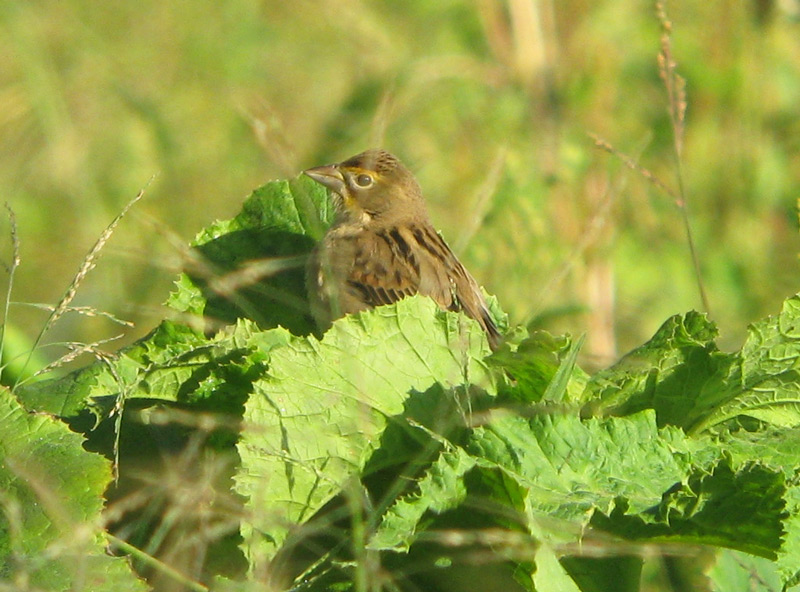
The first frosts have really brought home the fact that we're well into October so after dropping off Matan at school, I couldn't resist a local drive to check some sparrow fields on River Road in Gill. I first came across the fields on October 5th, actually pumpkin fields, and found the weedy fringes full of birds. This morning was a similar story, but I also found some obvious new arrivals - a Dickcissel and at least three White-crowned Sparrows.
Here's a list of the more interesting species present on both the 5th and 7th unless stated otherwise;
60 Savannah Sparrows, 45 White-throated Sparrows, 3 White-crowned Sparrows (all on 7th, including one potentially showing characteristics of the gambelli form).
White-crowned Sparrow - individual with plain lores (recalling Field Sparrow) showing some resemblance to gambelli form. River Road, Gill, Franklin Co., MA. October 7th, 2011.1 Field Sparrow (on 7th only), 12 Chipping Sparrows, 6 Lincoln's Sparrows, 5 Swamp Sparrows, 50 Song Sparrows, 1 Dickcissel (on 7th only). Also, a few warblers around including up to three Eastern Palm Warblers, plus one Western Palm on the 5th, this being one of only a handful of Westerns I've seen in the Pioneer Valley in fall. Also today, 2 Nashville Warblers and a couple of Common Yellowthroats, plus a Blue-headed Vireo calling from the woods.
Several Pine Siskins flew over this site on both the 5th and the 7th.
PS. Five or six each of American Pipit and Indigo Bunting were also present on the dates mentioned above.
Happy Autumn,
JPS
Friday, September 2, 2011
MA - yellowlegs and waterthrush - 09/02
A few casual observations from the day revealing more cool birds in our local area (Gill). Swung by Barton Cove this morning, again finding no sign of the phalarope from August 31st but 4 Lesser and 1 Greater Yellowlegs were really nice. The birds fed briefly in the shallows off Riverview Drive but without enough muddy margins to keep them there, they moved quickly on down river. A Purple Finch was calling from the same spot, and there was another Purple Finch, this time a singing bird, in our yard around noon. Yard bird of the day was a nice Northern Waterthrush this evening, located by call in the Alder patch.
Elsewhere, an unidentified cuckoo in flight over Rt 2 in Greenfield, and an Indigo Bunting still singing at Upinngil Farm this evening. Great stuff!
JPS.
Elsewhere, an unidentified cuckoo in flight over Rt 2 in Greenfield, and an Indigo Bunting still singing at Upinngil Farm this evening. Great stuff!
JPS.
Thursday, September 1, 2011
MA - Pec Sand and Common Nighthawk - 09/01
September at last, and thank goodness for increasingly cool nights and foggy, autumnal dawns.
Two nice local sightings today, as if to welcome one of the most exciting birding months on the calender. This morning I saw heard, then saw a Pectoral Sandpiper flying around Upinngil Farm with a small flock of Feral Doves and Starlings! It spent a good seven minutes circling the fields and paddocks in the area before heading off North.
And this evening, between the thundery showers, a Common Nighthawk over Rt 2 in Gill near the intersection with Main Road and the Turner's Falls bridge.
Of note, the calls of Red-eyed Vireos and Eastern Wood Pewees have been common sounds through out Gill over the last two days.
Alas, a brief check of Barton Cove in mid-morning did not produce any sign of yesterday's Re-necked Phalarope though I did see a Great Black-backed Gull, 7 Ring-billed Gulls and 4 or 5 immature Bald Eagles.
JPS
Wednesday, August 31, 2011
MA - Red-necked Phalarope in Gill - 08/30
Red-necked Phalarope - (juvenile), Connecticut River at Barton Cove, Riverview Drive, Gill, Franklin Co., MA. August 31st, 2011.
Since Hurricane Irene hit our area on Sunday, August 28th, I've made a few casual 'passes' through Barton Cove hoping for the odd stray, or perhaps a bird getting re-orientated after the storm. Sunday's storm did produce some stellar pelagic species either side of the Connecticut River Valley with White-tailed Tropicbirds, Sooty Terns and storm-petrels being reported inland from Winsor Dam in the Quabbin, and from Lake Onota in Pittsfield. The only 'storm birds' I could muster during two hours at Barton Cove on Sunday were five Common Terns and a very brief juvenile Red-necked Phalarope.
Anyhow, it looks like the phalarope may lingered in the cove, recuperating and getting ready for the next stage of its migration. Today, I had great views as it picked morsels from the debris and flotsam in the main river channel just off Riverview Drive in Gill. The bird was constantly drifting downstream on the current and then flying back upriver for two hundred meters or so before floating back down once again, feeding as it drifted.
Also of note today, my first Palm Warblers of the fall, both of them Western types, one off Mountain Road in Gill and one on Riverview Drive, also in Gill.
Thursday, July 7, 2011
NC - Band-rumped Storm-petrels - 05/25-26/11
Band-rumped Storm-petrel - Gulf stream waters, SE of Hatteras Inlet, North Carolina - May 26th, 2011. Flight style often compared to a small shearwater and somewhat evident in this shot. Overall quite warm brown, not so black-brown as Wilson's Storm-petrel. Digi-bin shot, along with all the other images in this post, taken using Canon Powershot A560 and Leica 8 x 42 binoculars.______________________________________________________________________________________________
*NB. There are still some spaces available on the forthcoming BBC Extreme Pelagic departing from Hyannis, MA at 4am on Saturday July 16th, 2011. The trip will target core eddies of warm water at the edge of the Continental Shelf which may attract rare species typically associated with the Gulf Stream. Band-rumped Storm-petrels will be high on the list of possible species, along with Audubon's Shearwaters, Bridled Terns and perhaps White-faced Storm-petrels. Rarities are being detected with increasing frequency on these trips and a rare pterodroma, such as the Black-capped Petrel we found July 2009, will be high on the 'wish list' for many.
Full details are available from Ida Giriunas; ida8@verizon.net
_______________________________________________________________________________________________
Yet another dedicated offshore pelagic with the Brookline Bird Club is fast approaching, departing on Saturday July 16th. It seems like as good a time as any for a quick review of the Band-rumped Storm-petrels images I collected in North Carolina in late May.
Aside from Black-capped Petrels and the reasonable possibility of rarities, one of the species that I really hoped to see well on the North Carolina pelagics was Band-rumped Storm-petrel. My previous experience of Band-rumpeds was limited to just a handful of individuals seen rather fleetingly on the BBC extreme pelagics. Two days of pelagics off Cape Hatteras on May 25th and 26th produced about half a dozen Band-rumpeds on each day. They were often shy, rarely coming close to the boat and usually passed through the chum-slick without really hanging around (unlike the many tens of Wilson's Storm-petrels). It did, however, provide the opportunity I was looking for to get a firmer grasp of key identification features compared to Wilson's and Leach's Storm-petrels. My level of comfort increased with each and every observation and, once again, I was reminded that there is absolutely no substitute for field experience!
The photographers on board spoke of this species as being notoriously difficult to capture in images, something with which I'd agree. Even so, despite the distance and speed with which these birds worked around the boat, I was quite happy to come away with a handful of digi-bin images. Impressively, the crew of the Stormy Petrel II worked really hard to ensure that everyone on board had acceptable views of Band-rumped Storm-petrels. Thanks to Brian and his crew for announcing every individual bird!
Band-rumped Storm-petrel - Gulf stream waters, SE of Hatteras Inlet, North Carolina - May 25th, 2011. This bird shows a chunky impression, with fairly 'muted' carpal bars and a fairly long, broad 'arm' compared to Wilson's SP. The tail of this bird is also slightly notched.
Band-rumped Storm-petrel - Gulf stream waters, SE of Hatteras Inlet, North Carolina - May 25th, 2011. This bird shows similar features to the bird above, with dull, sullied carpal bars and looking rather long-winged and heavy-billed, and with a narrow band of white across the rump.
Band-rumped Storm-petrel - Gulf stream waters, SE of Hatteras Inlet, North Carolina - May 25th, 2011.
Band-rumped Storm-petrel - Gulf stream waters, off Hatteras Inlet, North Carolina - May 25th, 2011. Again, hinting at the shearwater-like flight style, this bird showing obvious signs of primary molt.
Band-rumped Storm-petrel - Gulf stream waters, off Hatteras Inlet, North Carolina - May 25th, 2011. Always looking longer winged and warmer brown compared to the many Wilson's Storm-petrels present.
Band-rumped Storm-petrel (lower right) - Gulf stream waters, SE of Hatteras Inlet, North Carolina - May 25th, 2011. With Wilson's Storm-petrel (upper left).
Band-rumped Storm-petrel (upper left) - Gulf stream waters, SE of Hatteras Inlet, North Carolina - May 25th, 2011. With Wilson's Storm-petrel (lower right). Even on this poor shot, the Band-rumped SP looks larger, browner and longer-winged than the small, blackish-brown Wilson's SP.
Bob Fogg - hard at work on the bow of the Stormy Petrell II, one of Brian Patteson's very capable team of leaders. Gulf stream waters, SE of Hatteras Inlet, North Carolina - May 25th, 2011.
Friday, July 1, 2011
ME - Chasing a 'Mega' - 06/30
Little Egret - Scarborough Marsh, ME. June 30th, 2011. First state record found by Doug Hitchcox on June 29th, 2011 - an ABA Code 4 species. Views off the Eastern Road Trail proved to be distant at all times, but the extra-ordinary nape plumes, in combination with greenish-gray lores and straight black bill provided relatively 'easy' separation from the neighboring Snow Egrets. Kudos to Doug for his excellent bird finding and obvious knowledge of the key identification features for separating these two very similar species.On June 29th Steve Mirick forwarded a message from the Maine list-serve describing a Little Egret that Doug Hitchcox had found and photographed at Scarborough Marsh just south of Portland. I already had fond memories of this marsh, a spot which had hosted another 'mega' in the form of a European Golden Plover, which Susannah, Matan and I traveled to see on October 11th, 2008.
Having lived in New England since 2003, I couldn't recall hearing of a solid report of a Little Egret in any of the New England states in recent years, though I was aware of two historical records for Massachusetts (1989 & 1992). It wouldn't be an exaggeration to say that I've seen many tens of thousands of Little Egrets in the Old World, mostly in Israel but also on my travels in Europe, Asia and Africa. But I'd never come across one in North America, or had the opportunity to chase one so close to home!
With no further reports through the early morning of June 30th, but with the knowledge that the bird had been seen for most of the 29th, I decided to take my chances and set off from Gill in mid-morning. Wrestling with holiday traffic heading into New Hampshire and Maine was no fun and I arrived at the scene much later than I wanted to at 1:30pm. Luckily, the first birder I spoke to had just seen the egret and I walked along the trail to join Steve Grinley and Margo Goetschkes, remarkably the only birders present at the time. A few other birders came and went but I was surprised not to see more people at the scene. The Little Egret was in view, albeit distantly, throughout the 75 minutes that I spent at Scarborough Marsh, at times feeding alongside Snowy Egrets, Little Blue Heron and Glossy Ibis. Aside from myriads of tiny black biting flies, the marshes were full of the sounds of Eastern Willets, Bobolinks, and both sharp-tailed sparrows - Nelson's and Saltmarsh - all in all, a very pleasant experience and well worth the drive from Western Mass.
JPS.

This shot, and the one below, were taken with a Panasonic Lumix FZ 40 - one of the so called 'super-zoom' cameras. Here the Little Egret is the right most bird in both shots, with Snowy Egrets and a Glossy Ibis further left. Even on these distant 'grainy' images the extended nape plumes stand out as a key feature.

Friday, June 24, 2011
MA - more Orchard Orioles, plus Willow Flycatcher in Gill - 06/24


Orchard Oriole - Gill, Franklin Co., MA. June 24th, 2011. Male of a breeding pair close to the Connecticut River off River Road in Gill.

Aside from a few incidental observations, and feeling like I'd neglected local field birding this month, I decided to check a small cattail pond off River Road in Gill this morning. The pond held no less than 4 Virginia Rails on May 6th, so I returned with confidence hoping to at least hear a couple of rails, perhaps with a very long shot at Least Bittern. I came up empty on both species but the morning yielded a nice surprise in the form of a breeding pair of Orchard Orioles. The male showed best, occasionally bursting into song, the female being rather more shy and furtive. To add to the flavor of primarily south-eastern species, two Yellow-throated Vireos were singing along River Road as soon as I stopped the car.
I also enjoyed close views of a singing and calling Willow Flycatcher at the same spot whilst Red-tailed and Broad-winged Hawks soared overhead, along with numerous Turkey Vultures. Back home in Gill, a Belted Kingfisher and a Louisiana Waterthrush were on the brook behind the house this morning.
Cedar Waxwing - Gill, Franklin Co., MA. June 24th, 2011. One of about a dozen feeding at the edge of the cattail pond. JPS.
Thursday, June 23, 2011
MA - Yellow-throated Vireo and Orchard Oriole - 06/20
Slightly belated post but still notable, concerning a couple of cool yard birds from our home in Gill on Monday June 20th. The first was a singing Yellow-throated Vireo high in the Sugar Maples in the morning, a nice compliment to the daily Red-eyed and Warbling Vireos which seem to go on singing all day long, rain or shine! Later in the afternoon, there was a brief but loud burst of Orchard Oriole song, the first I've heard since this bird visited our yard on June 7th. It's likely the same bird which may have set up a territory close to our yard.
Elsewhere, Willow Flycatchers continue to sing 'fitz-bew' from the sedge meadow to the SW of our yard, whilst the Alder Flycatchers seemed to have ceased singing but can still be located by their distinctive 'pip' calls.
Eastern Kingbirds, Eastern Bluebirds, Indigo Buntings and Baltimore Orioles remain extremely visible and audible members of our birding community. Less so is the Louisiana Waterthrush which is still present, but still extremely shy, on the brook that runs through our yard. Attempts (by me) to find a nest have failed so far. Still on the waterthrush theme, a run along Green River Road in Leyden on the same morning (June 20th) produced at least 15 Louisiana Waterthrushes, some still singing but most calling or seen along the river and adjacent streams. I heard a similar number of mostly singing birds here on the previous weekend of June 12th.
All in all, a pleasant but fairly stable period bird wise and yet, remarkably, we will soon see the first signs of fall migration as south-bound shorebirds, fresh back from the Arctic, will start to gather along the coast.
JPS.
Subscribe to:
Posts (Atom)