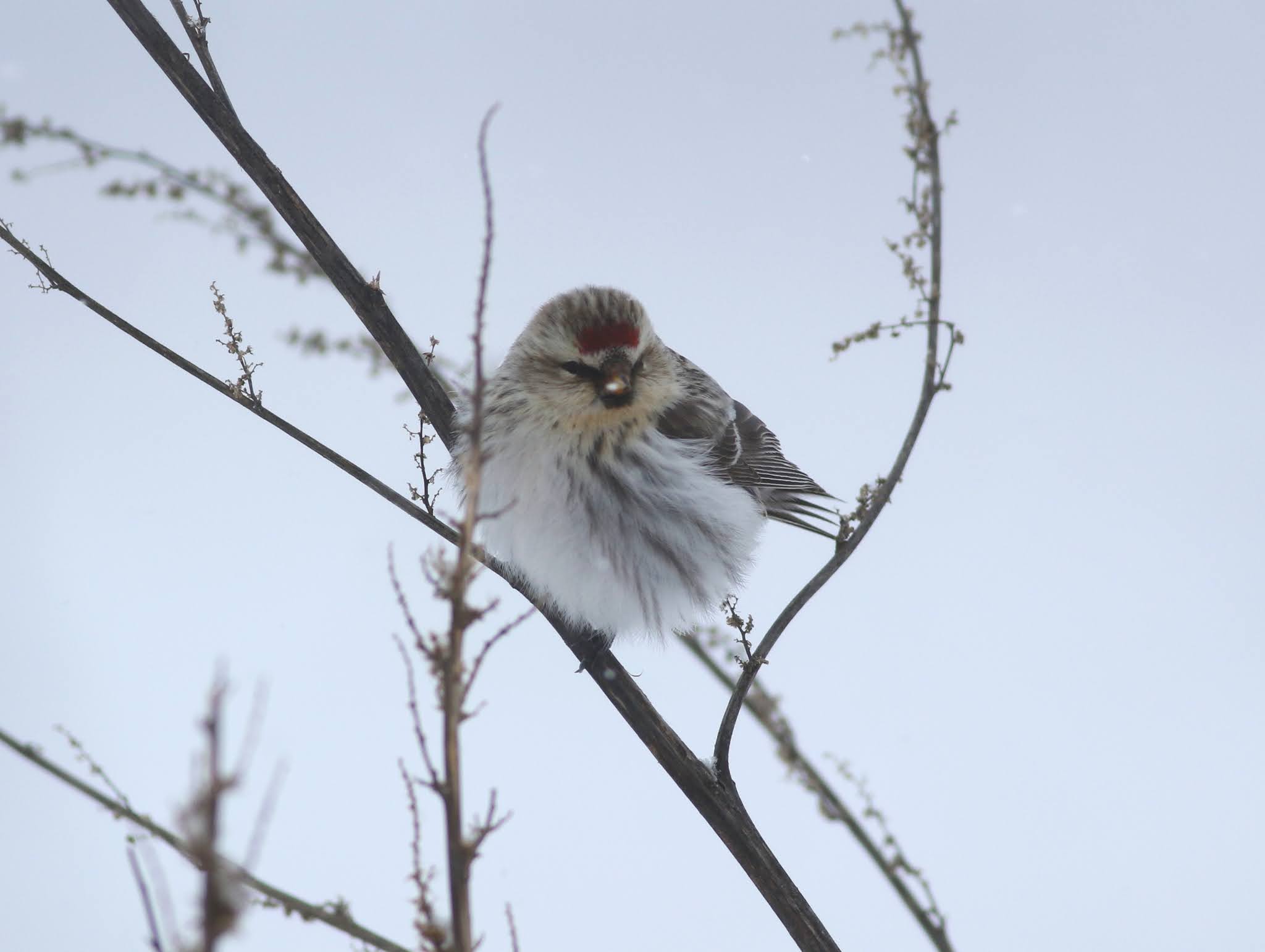
Flocks of redpolls are still with us for the time being though I imagine with increasingly spring-like conditions we'll see them departing quite soon. Today I came across two flocks, 65 in Whately and about 28 at the Turner's Falls power canal. The Whately birds again surprised me by perching unobtrusively in the sumac thickets while the Turner's Falls flock gave no indication of their presence until I saw them disappearing in flight. On the plus side, the Whately flock contained an absolute spanking Hoary Redpoll and, despite the Common Redpolls within the flock appearing increasingly pale and worn, the Hoary jumped out like the proverbial sore thumb! After admittedly grumbling about how few Hoaries appeared to be involved in the current incursion, I do feel that discovery of this bird in Buckland on January 31st marked a personal turning point in the winter with some really classic individuals showing up after that bird. Overall I've been pretty satisfied with appearance of birds like the one featured here and I'm quite happy to leave the more ambiguous individuals for another day.
Notes about birds, birding and travel from the Pioneer Valley in Western Massachusetts.
Monday, March 8, 2021
MA - another Hoary Redpoll
Wednesday, February 17, 2021
MA - February notes on Redpolls 7 : more exilipes
A few more shots of Hoary Redpolls from Whately last week. As usual, at least some of them should be regarded as tentative identifications. It was extremely difficult getting close to these birds and often very tricky trying to follow a promising looking individual before it flushed.
Monday, February 15, 2021
MA - February notes on Redpolls 6 : exilipes
Most of my luck with Hoary Redpolls last week actually came from the first morning with the Whately flock when I noted a 'promising' bird in the field but hadn't quite appreciated just how striking it was until I reviewed my photos at home. The bird featured here looks, to me at least, like a classic Hoary Redpoll, possibly a male A. e. exilipes.
MA - February notes on Redpolls 5 : 'Hoary-like' individuals
A self imposed quest to find Hoary Redpolls in Whately often led me to birds that appeared very Hoary-like in the field but after review of the photos at home I decided, at least for the time being, not to include them in the overall tally. Birds such as the three individuals featured here were present in numbers on each visit last week and I'm really not sure what to make of them. They left me with more questions than solid identifications and in this respect I'd have to admit to being happy only with the 'cleanest' examples of Hoary Redpoll.
Again I'm open to comment and guidance on any of these birds, but they do appear to fall a little short of my understanding of birds showing a solid set of Hoary Redpoll characteristics.
Saturday, February 13, 2021
MA - February notes on Redpolls 4 : flammea (more variation).
MA - February notes on Redpolls 3 : flammea (variants)
From a Franklin County perspective, the current incursion of winter finches has produced relatively few Hoary Redpolls. This certainly hasn't been down to a lack of effort and I don't mind admitting that I'm a little surprised as I was expecting/hoping that careful sorting through redpoll flocks would have turned up more than we've actually seen. On the other hand, the search for Hoaries has been a stark reminder of the somewhat bewildering variation within flocks of Common Redpoll Acanthis flammea flammea. Last week I spent a lot of time observing birds much like this one featured in Whately, primarily because of their overall similarity to some Hoary Redpolls but also because some, like this particular bird, were incredibly approachable. Seen at distance with other redpolls, it did stand out as being pale and somewhat Hoary-like. Watching at closer range, I was surprised how many of the features changed with posture and attitude, especially the undertail coverts which appeared only lightly streaked at some angles but well outside the acceptable range for Hoary Redpoll in others. The bill and head shape looked fairly typical for a Common Redpoll.
This pages features the same individual Common Redpoll with images taken within a few seconds of each other, and without any adjustments to camera settings or photoshop use.
Friday, February 12, 2021
MA - February notes on Redpolls 2 : the Whately flock
The fallow fields of Whately became the favored feeding haunt for fluctuating numbers of redpolls this week. While I'd noted redpolls in these fields on previous during the winter, February 6th produced only nine pretty skittish Common Redpolls so to find numbers had suddenly increased to c.300 birds on February 8th came as a genuine surprise. At that point I decided to check the flock more thoroughly and regularly with a view to keeping an eye on numbers throughout the week. February 9th was the biggest day with a minimum of 475 redpolls swirling about the fields during a winter weather event that deposited 2 - 4 inches of drizzly, wet snow over Franklin County. While the 9th was a tough day for actual observations, the fields had clearly 'sucked' in numerous redpoll flocks from the surrounding countryside that converged to form one impressive heaving mass. Numbers then dropped steadily during the remainder of the week (250 on the 10th, 120 on the 11th and 75 on the 12th). My morning session on the 12th ended abruptly at 10:45 am when a Merlin swept through the fields dispersing the entire remaining flock of 75 birds. They headed off SW without returning.
The large numbers of passerines within the Whately fields became a major draw for raptors too with the regular presence of 2 - 3 Northern Harriers, 2 - 3 Red-tailed Hawks and a Cooper's Hawk as well as the previously mentioned Merlin. Aside from the redpoll flock the fields were positively flush with other passerines and, while numbers varied from day to day, it was possible to see up to 120 Snow Buntings, 35 Horned Larks, 140 American Tree Sparrows, 65 Dark-eyed Juncos, 12 Savannah Sparrows, 12 Song Sparrows and about 9 White-throated Sparrows though the latter tended to stick close the surrounding hedgerows rather than the open fields.